The article “Flies, pathogens, and wildlife: Tsetse stories and disease vulnerabilities between eradication and coexistence in Zambia” has just been published in the journal Environmental and Planning E: Nature and Space. Check it out here!
Tsetse flies and wildlife-disease reservoirs have long been targeted for spreading trypanosomiasis, an infectious parasitic disease that affects multiple organs in humans and livestock. In Zambia, large-scale conservation promotes closer coexistence between people, livestock and wildlife, renewing concerns: how can people live with dreadful pathogens?
This article explores the shifting stories that cast tsetse flies variously as epidemic villains, guardians of wilderness, and awkward neighbours. It aims to unravel the imaginaries, technological and spatial assemblages underlying tsetse stories to understand how they shape disease control and encounters with tsetse.
Drawing on archives, entomological literature and interviews with local farmers in southwestern Zambia, the study moves between science, fiction, and local narratives to examine tsetse stories of the 20th and 21st centuries in Zambia (and beyond). It highlights how these stories shape the fears and possibilities of living with tsetse, between eradication and coexistence.
Overall, the article shows that vulnerabilities to trypanosomiasis are produced and responded to in political assemblages, and asks: what kinds of multispecies worlds do we want to narrate and inhabit?
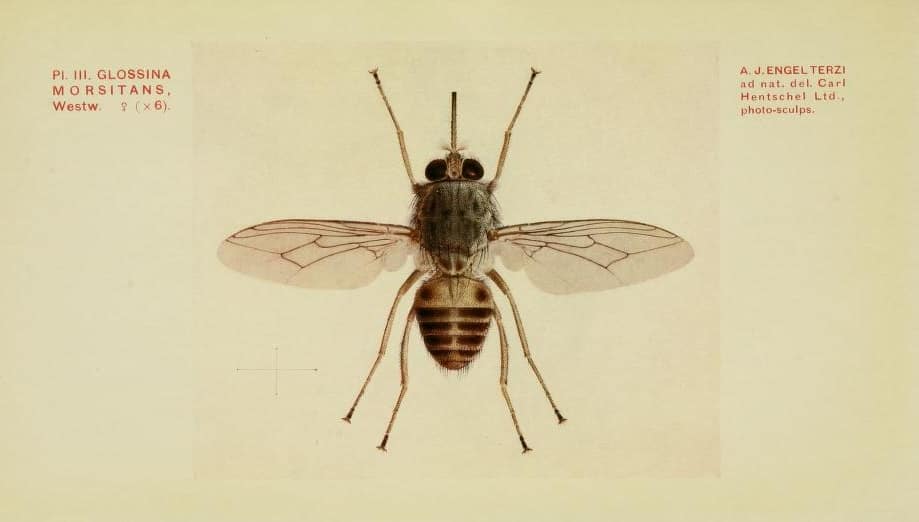
Image from Austen 1903, A Monograph on the Tsetse Flies. Plate III and Fig. I. Creative Commons Public Domain. Accessible at: https://archive.org/details/monographoftsets00aust