New publication: “Flies, pathogens, and wildlife”

The article “Flies, pathogens, and wildlife: Tsetse stories and disease vulnerabilities between eradication and coexistence in Zambia” has just been published in the journal Environmental and Planning E: Nature and Space. Check it out here!

Tsetse flies and wildlife-disease reservoirs have long been targeted for spreading trypanosomiasis, an infectious parasitic disease that affects multiple organs in humans and livestock. In Zambia, large-scale conservation promotes closer coexistence between people, livestock and wildlife, renewing concerns: how can people live with dreadful pathogens?

This article explores the shifting stories that cast tsetse flies variously as epidemic villains, guardians of wilderness, and awkward neighbours. It aims to unravel the imaginaries, technological and spatial assemblages underlying tsetse stories to understand how they shape disease control and encounters with tsetse.

Drawing on archives, entomological literature and interviews with local farmers in southwestern Zambia, the study moves between science, fiction, and local narratives to examine tsetse stories of the 20th and 21st centuries in Zambia (and beyond). It highlights how these stories shape the fears and possibilities of living with tsetse, between eradication and coexistence.

Overall, the article shows that vulnerabilities to trypanosomiasis are produced and responded to in political assemblages, and asks: what kinds of multispecies worlds do we want to narrate and inhabit?


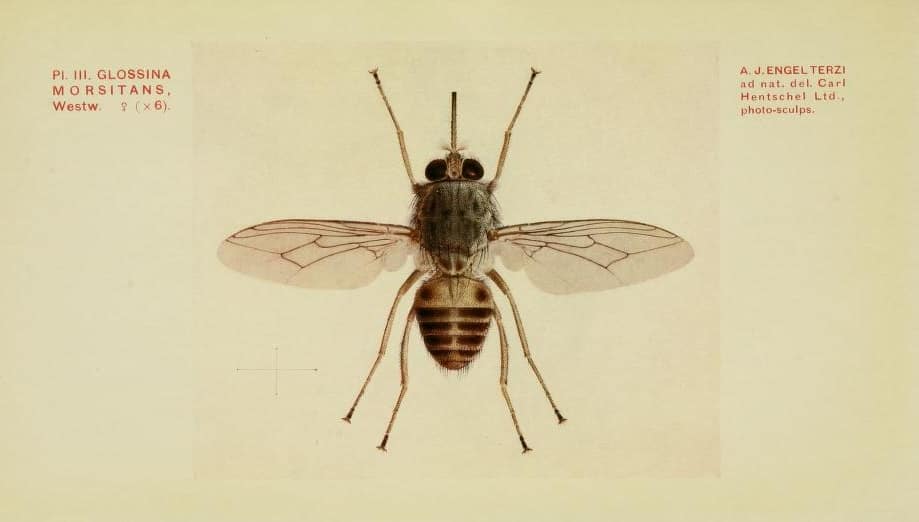
Image from Austen 1903, A Monograph on the Tsetse Flies. Plate III and Fig. I. Creative Commons Public Domain. Accessible at: https://archive.org/details/monographoftsets00aust
More News

Call for Pitches & Participation – Workshop (8.-9. Oktober 2026), LMU München

Image: Niklas Schrade c/o Realfiktion Klimarechnungshof, Wien 2023 Impulse für eine öffentliche und engagierte Umweltanthropologie. Konzepte, Perspektiven und Politiken * English below Themen wie Ökologie ...
Read More

New publication: “Provincializing Foot-and-Mouth Disease”

How have we come to know foot-and-mouth disease (FMD), one of the most important transboundary animal diseases in the world? In a new publication, Wisse ...
Read More

Interdisciplinary workshop “The Planetary Legacy of Colonial Forests in the Anthropocene”

Click here to view programme Hosts Rewilding the Anthropocene (European Research Council Advanced Grant project) and the Global South Studies Center (GSSC), University of Cologne ...
Read More

New article on wildlife corridors in the KAZA Transfrontier Conservation Area

The new article “Elephant corridors in the Kavango-Zambezi transfrontier conservation area (KAZA TFCA): environmental infrastructures for a greener anthropocene in Namibia’s Mudumu landscape” by Emilie Köhler ...
Read More

Upcoming workshop in Botswana: Human-Carnivore Co-adaptation. Exploring changing behaviours, perceptions and (research) practices

Click here to view program Hosts Global South Studies Center (GSSC), the University of Cologne Rewilding the Anthropocene – A European Research Council Advanced Grant ...
Read More

Elephant Modernities: Thinking along blurry lines between humans, elephants and technologies – An interdisciplinary workshop

Click here to view program HostsGlobal South Studies Center (GSSC), the University of CologneRewilding the Anthropocene – A European Research Council Advanced Grant Project OrganizersProf. ...
Read More

© All Rights Reserved 2022

Scroll to Top